

![Item #3706028 Strabonis rerum Geographicarum Libri XVII [Strabo's seventeen books on geographical matters]. STRABO, Strabo of Amasia.](https://hordern.cdn.bibliopolis.com/pictures/3706028.jpg?width=768&height=1000&fit=bounds&auto=webp&v=1698649098)
![Strabonis rerum Geographicarum Libri XVII [Strabo's seventeen books on geographical matters].](https://hordern.cdn.bibliopolis.com/pictures/3706028_02.jpg?auto=webp&v=1698649099)
![Strabonis rerum Geographicarum Libri XVII [Strabo's seventeen books on geographical matters].](https://hordern.cdn.bibliopolis.com/pictures/3706028_03.jpg?auto=webp&v=1698649099)
![Strabonis rerum Geographicarum Libri XVII [Strabo's seventeen books on geographical matters].](https://hordern.cdn.bibliopolis.com/pictures/3706028_04.jpg?auto=webp&v=1698649099)
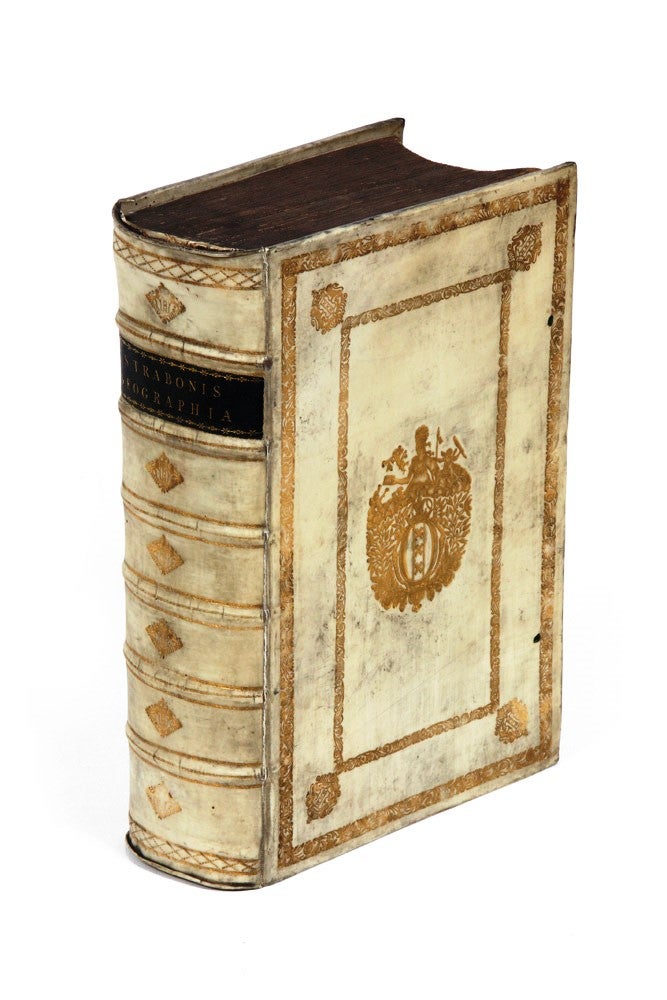
Strabonis rerum Geographicarum Libri XVII…
Strabonis rerum Geographicarum Libri XVII [Strabo's seventeen books on geographical matters].
Amsterdam: Joannes Wolters, 1707.
Folio, with a fine engraved title-page, parallel text in Greek and Latin in double columns; a very handsome copy in its original vellum binding, covers ornately gilt with complex central medallion (see below), spine decorated in gilt between raised bands; original ribbon ties discarded.
Splendid prize binding on the 1707 Strabo
A splendid copy of the best edition of Strabo's enormous Geography, in an original special Amsterdam "prijsband" or prize binding of vellum heavily decorated in gilt, intended for presentation to gifted students. The central gilt medallion on both covers is a flourished version of the coat-of-arms of Amsterdam, a triple-'X' shield, which is enclosed by an ornate laurel wreath and topped by a crown, alongside allegorical figures. The chief such figure is the Stedenmaagd—the City Maiden or Town Virgin of Amsterdam—while both she and the putti beswide her carry books and inkpots in a nod to scholarship. On both covers, at each corner of the gilt border surrounding the medallion, are small versions of the city's triple-'X' arms.
A splendid copy of the best edition of Strabo's enormous Geography, in an original special Amsterdam "prijsband" or prize binding of vellum heavily decorated in gilt, intended for presentation to gifted students. The central gilt medallion on both covers is a flourished version of the coat-of-arms of Amsterdam, a triple-'X' shield, which is enclosed by an ornate laurel wreath and topped by a crown, alongside allegorical figures. The chief such figure is the Stedenmaagd—the City Maiden or Town Virgin of Amsterdam—while both she and the putti beswide her carry books and inkpots in a nod to scholarship. On both covers, at each corner of the gilt border surrounding the medallion, are small versions of the city's triple-'X' arms.
This was Strabo's kolossourgia or colossal work, as he described it himself. The influential Greek geographer who travelled widely, studied under both Aristotelian and Stoic teachers, and spent some decades in Rome, wrote his work early in the first century. Along with the less-known geographers Aratus and Geminus, Strabo promulgated the idea that the torrid zone of the spherical globe was occupied throughout its length by an ocean which divided his continent from another antipodal one in the southern hemisphere.
This edition is based on the critical edition by the great classical scholar Casaubon, here further edited with the addition of extensive notes from the best commentators, and with the addition of text that had been omitted from the sources available to Casaubon. "The annotations of preceding learned men are arranged with skill in their respective places, by the care and diligence of [this edition's editor] Almeloveen" (Dibdin).
The "Geographies" of Strabo were "by far the most important source for ancient geography, a priceless document of the Augustan age, and a compendium of important material derived from lost authors" (OCD). The work represents the classical world's most significant contribution to the science of geography. The first surviving attempt to collect all geographical knowledge that existed and to compose a general treatise on the subject, it was mainly based on ancient Greek sources. It survived in various manuscripts into the age of printing; however earlier printed editions of the text, including the Aldine edition of 1516, were based on corrupt manuscripts and it was not until 1587 that Casaubon improved the text for this edition, revising it again in 1620. Casaubon's edition of Strabo remained the basis of all subsequent editions until the nineteenth century.
For a very full modern analysis of the work see Daniela Dueck, Hugh Lindsay and Sarah Pothecary, Strabo's cultural geography: the making of a kolossourgia (Cambridge, 2005).
Provenance: Rochester Theological Library (with their discreet blindstamp on half-title and title).
Dibdin, II 433; Moss, II 621.
Condition Report: Slight crack to the vellum at front joint of binding but firm.
Price (AUD): $4,250.00
US$3,020.09 Other currencies