

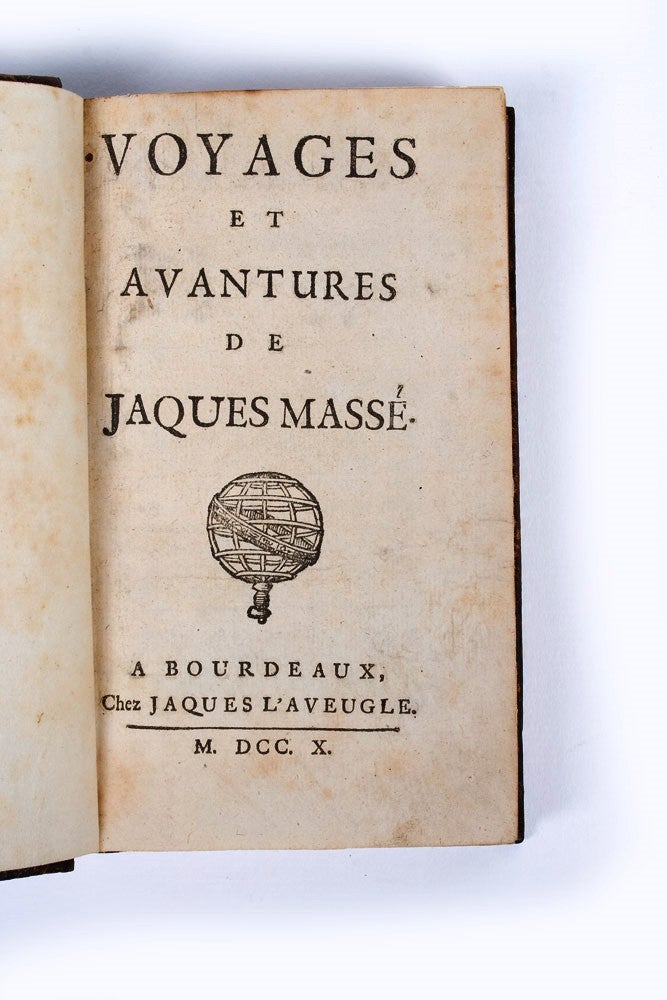
Voyages et Avantures de Jaques Massé.
Bordeaux: chez Jacques l'Aveugle, 1710.
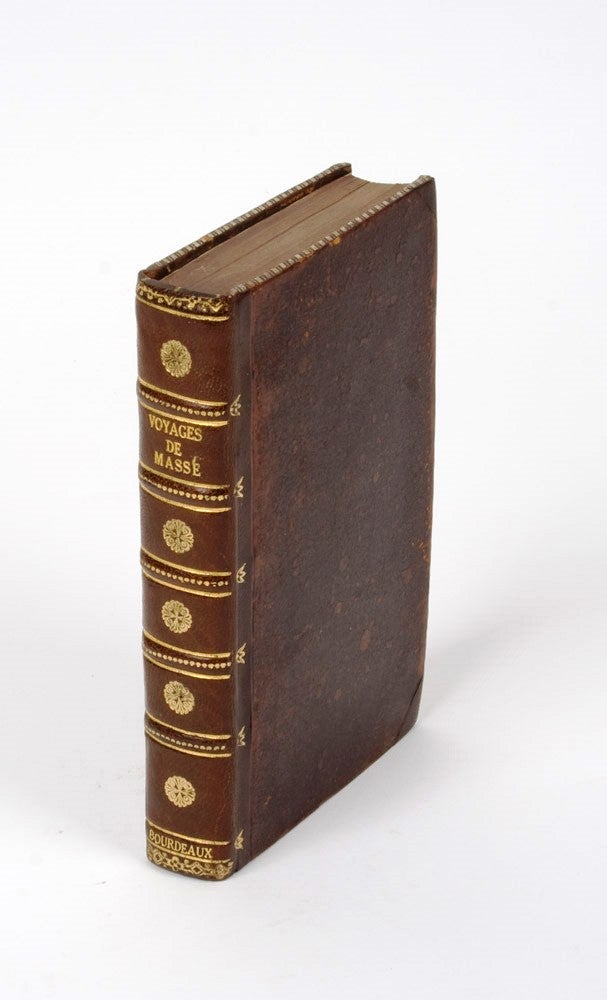
Duodecimo, with woodcut device on title; original sprinkled calf binding.
The Australians are obsessed with mining
First edition (Rosenberg edition 'A'), of this important imaginary voyage to Australia: a "landmark" in the development of the French voyage novel (Atkinson). Friederich comments that the importance of mining and irrigation to the Australians makes it the only work "to foreshadow what has actually come to pass in modern Australia".
First edition (Rosenberg edition 'A'), of this important imaginary voyage to Australia: a "landmark" in the development of the French voyage novel (Atkinson). Friederich comments that the importance of mining and irrigation to the Australians makes it the only work "to foreshadow what has actually come to pass in modern Australia".
This is an attractive copy of this precursor to Defoe, set on the Australian continent among people obsessed with mining and the problems of irrigation: "the detailed account of the adventurer's camp in the Austral continent, the building of a raft, and the descriptions of plants and trees, may be compared favourably to similar passages in Robinson Crusoe…" (Atkinson).
The author Tyssot de Patot was a remarkable figure, an English-born Huguenot and self-taught philosopher with a background in mathematics who, at the impressive age of 72, suddenly scandalized his Dutch community and was run out of town as a dangerous heretic. He wrote two wonderfully inventive imaginary voyages, both well ahead of their time: one was an account of a journey deep underground into a hollow earth, while the present work tells the story of a veteran sailor called Jacques Massé who shipwrecks in the far southern reaches of the Indian Ocean, not far from what is now Kerguelen Island. Delighted with the new world he discovers, Massé denounces his European heritage, only to be betrayed and have to flee to the coast, where he is besieged for 12 years before being finally rescued by a Portuguese ship.
The work was a modest bestseller of the era, and the question of editions has been thoroughly investigated by Aubrey Rosenberg, no small task given that all four major editions are dated 1710 on the title-page. Rosenberg argues that this edition, 'A' in his list, with an armillary sphere device on the title with its base pointing to the left, was probably published between 1714 and 1717, and is the true first edition of the work. As Rosenberg points out, this series of editions dispels the notion that interest in Tyssot quickly died out: in fact, the staggered publications argue a sustained interest in the work throughout the eighteenth century.
Tyssot de Patot's writings were a continual source of scandal: Voltaire thought that he had "carried the torch of discord into their homeland". Certainly the antagonistically anti-religious stance of this novel created much ill-feeling. Atkinson comments that because "open criticism of the Bible is so frequent" he will have to content himself with listing just a few of the more extreme examples. Nonetheless, Atkinson's positive summary gives a good sense of the importance of the work: "a close following of accounts of real travellers, such as Dellon, Tavernier, Mocquet, and Lahontan. There is nothing fantastic, unbelievable or overdrawn in the descriptions of the Austral continent…".
---
The story has Massé shipwrecking on the Southern continent at "44 South latitude, almost at the point where Kerguelen Island will be found to be on modern maps" (Atkinson). Whilst most of the survivors of the wreck are content to maintain a large presence on the coast, Massé and his friend Moret travel inland where they settle in an enormous and well-organised utopia, "a plentiful, fruitful country, a land of blessing and peace … where human blood is sacred and safe from the rage and tyranny of great men". They become so enamoured of their Australian hosts that they abjure their faith and their European heritage, and it is only when Moret is betrayed by his liaison with a treacherous queen that they reluctantly flee, escaping rather fortuitously by a subterranean river which deposits them close by the original settlement. They remain besieged in the camp for another twelve years before they are finally picked up by a Portuguese ship.
Provenance: James Hustler ("of Acklam in Cleveland in the North Riding of the Country of York Esq.", engraved armorial bookplate dated 1730); Bernard Gore Brett (Melbourne book collector).
Rosenberg, Edition 'A', p. 84-5.
Condition Report: Extremities slightly rubbed, rebacked, corners reinforced, a very good copy.
Price (AUD): $3,200.00
US$2,242.70 Other currencies